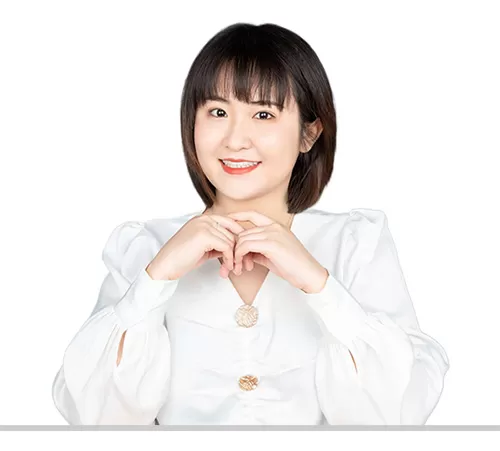








“The question is not only whether a supplier calls itself a factory. The real question is: who controls the formula, quality, lead time, and response when something goes wrong?”
— Sunny | Head of International Business at TY Cosmetic | 13+ years in cosmetics OEM/ODM
For growing beauty brands, e-commerce sellers, sourcing leaders, and product managers
Why Would a Growing Body Care Brand Rethink Its China Supply Chain?
Not long ago, the founder of an established body care brand from an overseas market spoke candidly with one of our project managers about his previous sourcing experience in China. The brand had already achieved meaningful commercial traction and was preparing to expand its product line.
A brand at that stage should have increasing confidence in its supply chain. Yet when our project manager asked why he was considering a new sourcing partner, his answer came down to four short phrases:
“Lack of transparency. On the lead time. On the ingredients. Bad communication.”
— Overseas body care brand owner, quoted anonymously
Those concerns pointed to a broader structural problem: the brand’s communication passed through an intermediary, with limited direct access to the people responsible for formulation and production. The issue was not simply that another party was involved; it was that the brand could not clearly see how information, decisions, and accountability moved through the supply chain.
“That’s why I came to China to control my supply chain myself.”
— Client’s original words, identity withheld
The Question Every Brand Should Clarify Before Sampling
As the discussion moved toward sampling, it raised a more important governance question: who is authorized to represent the brand, issue product instructions, approve changes, and release the final order?
Cosmetics projects often involve several legitimate participants: a brand owner, distributor, sourcing company, consultant, export entity, packaging supplier, and manufacturer. Having several parties is not automatically a problem. The risk appears when their roles are undisclosed or when the actual manufacturer cannot verify whose instructions are final.
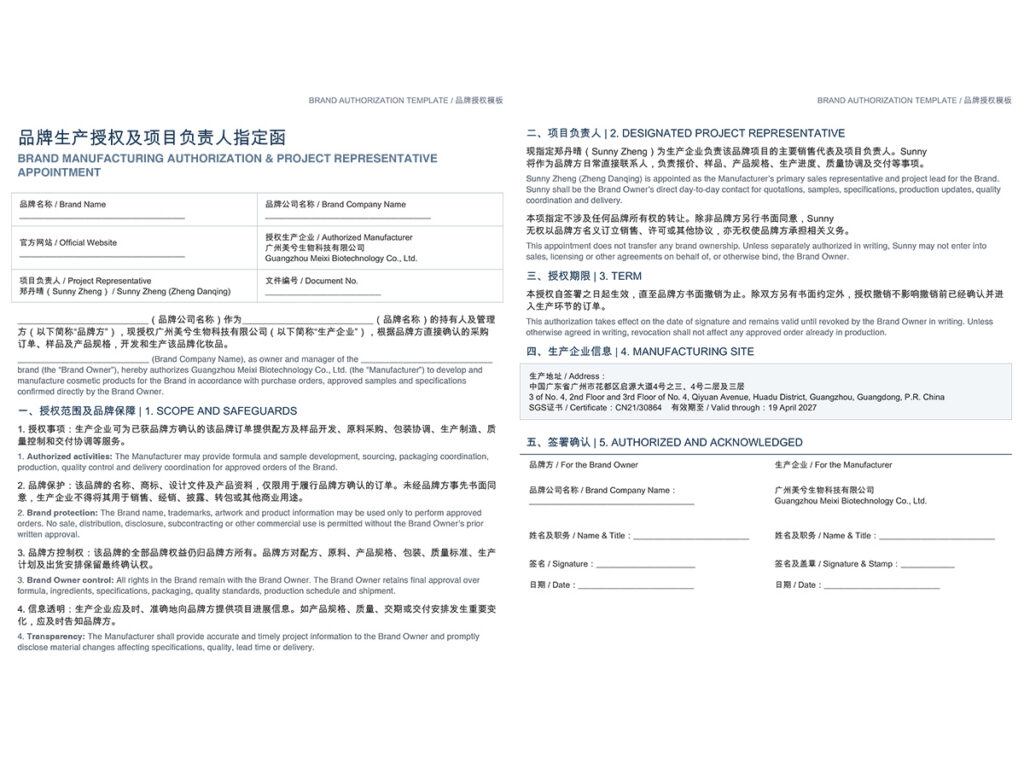
For a new project, the safest approach is to document the current authorization and approval pathway before core brand assets are used. A manufacturing authorization and project representative letter can identify the brand owner, the authorized manufacturing entity, the permitted scope of work, the designated representative, and the decisions that remain subject to the brand owner’s final approval.
“Before a sample is developed under a brand name, every party should know who owns the brand, who may issue instructions, and who gives final approval.”
— Sunny
This approach is not designed to exclude legitimate intermediaries. It protects the brand owner, the manufacturer, and any properly authorized service partner by making responsibilities visible. It also reduces the risk of conflicting instructions, unauthorized use of trademarks or product files, unclear ownership of records, and disputes when quality or delivery issues arise.
Industry Reality No. 1: A High Google Ranking Does Not Mean a Company Is Close to the Production Line
Over 13 years in cosmetics OEM/ODM, I have reviewed many supplier websites built for overseas buyers. A polished site, a high Google ranking, or a large advertising budget proves that a company can generate leads. None of those things, by itself, proves that it holds a cosmetics manufacturing license, operates an R&D laboratory, or controls a production line.
Factory photographs, workshop videos, certificates, and the word “manufacturer” can be reused or presented without enough context. Even a third-party audit badge only relates to a particular legal entity, site, scope, and date. It does not automatically prove that the person speaking with you belongs to that entity—or that your order will be made at that facility.
This does not mean every trading company is a poor partner. A capable sourcing or trading company may add real value through language support, multi-category purchasing, packaging coordination, logistics, or local market service. The risk is not the word “Trading” in a company name. The risk is an undisclosed identity, a broken chain of responsibility, or a production relationship that the buyer cannot verify.
Manufacturer, Group Sales Company, Trader, or Individual Agent?
| Party | Potential value | What the brand must verify |
| Actual manufacturer | Direct control over formulation, quality, production, and retention samples | Valid license for the product category; manufacturing site; contracting party; quality accountability |
| Affiliated sales/export company | Language, export, payment, and project coordination | Written relationship with the plant; authority to represent it; allocation of quality responsibility |
| Independent trading company | Multi-factory sourcing, packaging, and logistics integration | Whether its role is disclosed; whether factories change; who owns records and accepts claims |
| Individual agent or commission intermediary | Local communication or introductions | Brand authorization; transparent compensation; whether information is being filtered or blocked |
For a brand, the most dangerous structure is not necessarily one with several companies. It is one in which each company holds only part of the information and no one accepts responsibility for the final product.
Industry Reality No. 2: An Extra Layer Costs More Than Its Markup
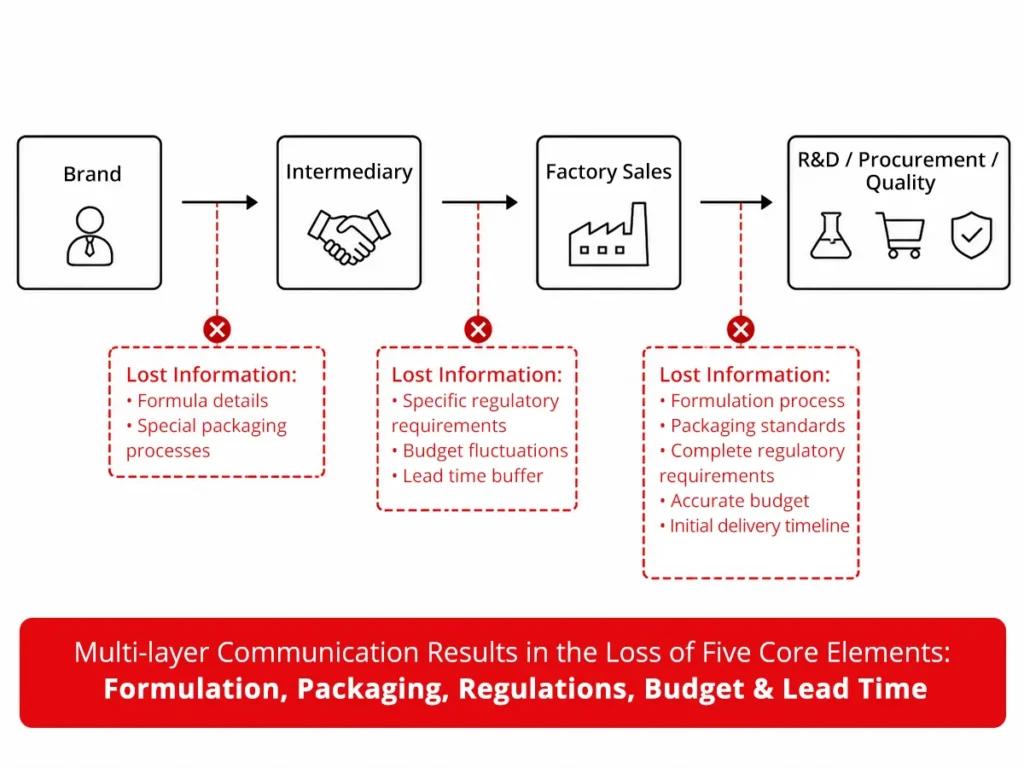
Many buyers assume the main disadvantage of an intermediary is a higher price. In cosmetics manufacturing, information loss can be far more expensive.
- The brand gives an intermediary its product concept, target skin feel, restricted ingredients, cost target, and launch deadline.
- The intermediary requests prices from several factories or removes details it considers unimportant.
- The manufacturer’s R&D team receives a second-hand brief and cannot ask the brand why a particular sensory result or claim matters.
- Packaging is sourced separately, while compatibility between the formula, pump, gasket, and container material is not fully validated.
- When leakage, discoloration, separation, odor change, or delay occurs, the parties debate responsibility instead of solving the problem.
In this case, the client described a multi-layered communication chain in which important requirements did not consistently reach the production team. The result, from the client’s perspective, was a product that did not fully meet expectations, limited ingredient visibility, uncertain lead times, and poor communication.
This is why a project manager close to the production team matters. The project manager may not formulate the product personally, but must translate the brand’s language into instructions that R&D, procurement, quality, production, and logistics can execute.
How to Verify That You Are Speaking With the Actual Manufacturer
There is no single magic document. Reliable verification comes from cross-checking the legal entity, manufacturing license, physical site, operating process, project records, and contractual responsibility.
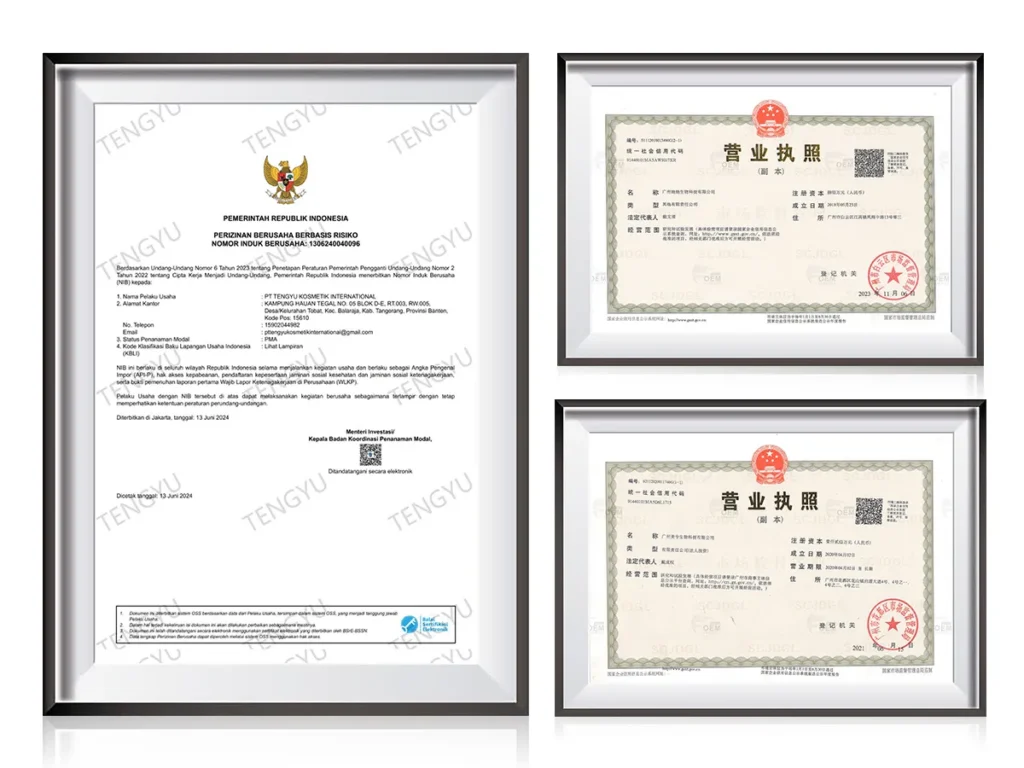
Layer 1: Verify the legal entity and manufacturing license
- Request the company’s complete Chinese legal name and Unified Social Credit Code.
- Request its cosmetics manufacturing license and confirm that the licensed site and product categories cover your project.
- Check the company’s active status and address through China’s official enterprise information system or a reputable corporate-data provider.
- Treat registered capital as one clue—not as proof of paid-in capital, capacity, equipment, staffing, licensing, or performance.
- If the contract party, payment recipient, exporter, and manufacturer are different entities, require a written explanation of their relationship and quality responsibilities.
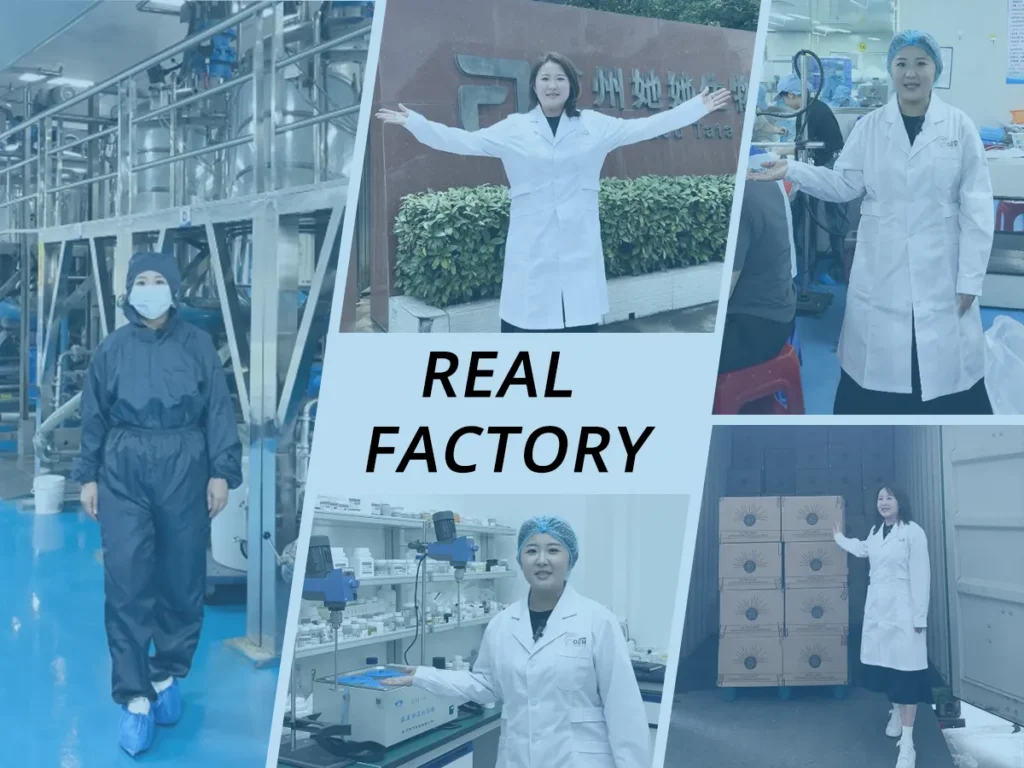
Layer 2: Request a live, interactive video tour
A prerecorded factory video is useful for orientation, but a genuine remote audit should respond to your instructions in real time.
- Begin at the company sign or security entrance, then continue through the site without unexplained cuts.
- Ask to see the R&D laboratory, raw-material and packaging warehouses, weighing, emulsification, filling, quality control, finished-goods warehouse, and retention-sample room.
- Request a view of a current production record, machine status, or specific area chosen during the call. Sensitive information can be covered.
- Observe whether the project manager understands site access, equipment functions, employees, process flow, and quality roles.
- Ask how water treatment, cleaning, sanitation, batch records, and retention samples are managed—and request examples of the record formats.
Layer 3: Ask questions that expose proximity to production
- Under which conditions is this formula most likely to become unstable, and what stability-test plan do you recommend?
- Which pump, gasket, and container materials are suitable for this oil-based or water-based formula?
- Who owns the fill, sealing, drop, temperature, and print-adhesion tests for the final packaging?
- Who approves the bill of materials, signed standard, and acceptable-limit sample before mass production?
- Which documents are needed for the destination market, and which must be supplied by the factory, brand owner, or local responsible person?
- If the first batch has color or odor variation, filling loss, or delay, what is the internal escalation path?
Layer 4: Verify certificates without being impressed by a certificate wall
ISO 22716, GMPC, SGS, Halal, amfori, and other audit or certification programs can provide useful evidence. Always check the legal entity, site address, scope, certificate number, issuing body, and validity date.
For products sold in the United States, distinguish FDA oversight and MoCRA facility registration/product listing from “FDA approval.” Ordinary cosmetics generally should not be promoted as “FDA-approved cosmetics,” and registration or listing is not an FDA endorsement of factory quality.
Industry Reality No. 3: The Project Manager May Matter More Than the Word “Factory”
A manufacturer can own production lines and still mishandle your project. In practice, your daily partner is the person who can mobilize resources inside that organization.
A cosmetics OEM/ODM project manager connects the brand with R&D, regulatory support, procurement, packaging suppliers, quality, production, and logistics. This person does not replace the engineers, but should know when to bring them into the conversation. The project manager does not inspect every packaging component personally, but must ensure the necessary testing happens before bulk purchasing.
“A project manager’s job is not merely to complete an order. It is to reduce uncertainty from product concept to market delivery.”
— Sunny
What should a strong project manager ask in the first meeting?
- What is the brand positioning, target customer, and sales channel?
- Where will the product be sold, and which regulations and label languages apply?
- What consumer problem should it address, and what texture, fragrance, skin feel, and use occasion are expected?
- Which ingredients are mandatory or expressly excluded?
- What are the target packaging, volume, first-order quantity, target cost, and launch date?
- Which trademarks, designs, benchmarks, samples, and product-brief materials does the brand already control?
If a supplier offers an unusually low price or sends a huge generic catalogue before understanding these points, the project is probably still in the lead-generation stage—not yet in technical evaluation.
12 Signs That a Project Manager Is Right for Your Brand
- Can restate your commercial and product goals—not merely repeat the product name.
- Explains trade-offs instead of answering “yes” to everything.
- Separates confirmed facts, professional judgment, and questions that require an engineer.
- Identifies conflicts among formula, packaging, regulation, timeline, MOQ, and budget.
- Pushes for packaging compatibility and appropriate safety testing before bulk production.
- Can bring R&D or quality personnel into a call when necessary.
- Provides milestones, owners, expected dates, and a change record.
- After charging reasonable sampling or packaging fees, reports what work those funds support.
- When a problem occurs, contains the impact and proposes options before debating blame.
- Will not promise an unrealistic MOQ, price, or lead time merely to win the order.
- Can enter the production site and understands manufacturing, quality, and warehouse operations.
- Leaves a complete company-owned project record, so continuity does not depend on one employee.
When should a responsible project manager say no?
A refusal is not always poor service. Sometimes it is evidence that the supplier is protecting the brand.
- The order is far below a practical production MOQ and the resulting cost would make the product uncompetitive.
- A requested change would create stability, safety, consumer-experience, or foreseeable after-sales risk.
- A buyer insists on an internet- or AI-assembled ingredient list while rejecting the formulator’s feasibility assessment.
- An unauthorized translator, agent, or individual requests a hidden commission that could harm the brand’s interests.
- Trademark ownership, brand authorization, or other intellectual-property rights cannot be confirmed.
The Step Many Brands Miss Before Sampling: Confirm Authorization and Confidentiality
As a general risk-control principle, an actual manufacturer should know whether an ordering party represents the brand owner, a distributor, an authorized agent, or another service provider—and what authority that party has for the current project.
Before sharing brand names, formulas, packaging designs, benchmark samples, sales information, or supplier networks, consider preparing two project-specific documents.
1. Manufacturing Authorization and Project Representative Letter
At minimum, the letter should identify:
- The brand owner and basic identifying information, such as the official website.
- The authorized manufacturing entity and manufacturing site.
- The permitted formulation, sampling, procurement, packaging, production, quality, and delivery activities.
- That the brand name, trademarks, designs, and product information may be used only for approved orders.
- That the brand owner retains final approval over formula, ingredients, specifications, packaging, quality, schedule, and shipment.
- The designated day-to-day project representative and the limits of that person’s authority.
- The validity period, revocation method, and treatment of orders already in production.
A clear authorization letter protects both parties: the factory knows who may place an order, while the brand controls who may use its assets and give instructions.
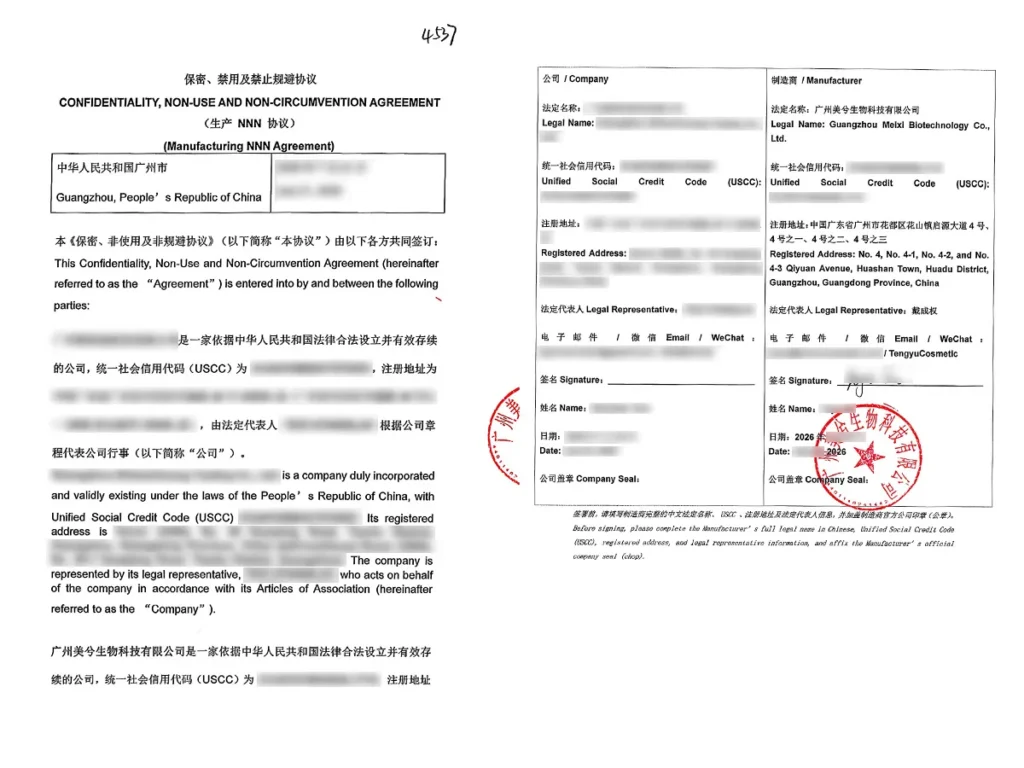
2. Confidentiality Agreement (NDA)
An NDA usually focuses on non-disclosure. In a manufacturing project, the brand may also need express non-use and non-circumvention clauses: the receiving party may not use formulas, designs, tooling, samples, customer relationships, or project information for another party, and may not use information gained through the project to bypass the brand.
A project-specific agreement may also address the definition and permitted use of confidential information, samples and tooling, intellectual property, evidence preservation, term, remedies, and dispute resolution. It should match the actual legal entities, transaction structure, and applicable law. A downloaded template is not a substitute for professional review.
This article is general risk-management information, not legal advice. Any binding agreement should be reviewed for the specific project by counsel familiar with Chinese manufacturing, intellectual property, and cross-border transactions.
A Practical Checklist for Auditing a Source Manufacturer
| Stage | Evidence the brand should receive | Red flags |
| First contact | Chinese legal name, manufacturing address, license details, project manager identity | Only an English trading name; refusal to identify the legal entity |
| Live tour | Continuous interactive video, requested route, project manager on site | Only edited footage; “confidentiality” used to refuse every real-time check |
| Sampling | Clear brief, formulation discussion record, version number, sample status | Sample source is unclear; versions are not tracked |
| Packaging | Material advice, compatibility/fill tests, signed or limit sample | Bulk packaging purchased before testing; appearance discussed without compatibility |
| Contract & payment | Written relationship among contract, payment, export, manufacturing, and quality parties | Payment requested to a personal account without a stamped explanation |
| Mass production | Approved BOM, schedule, first-piece or in-process checks, batch records | Long silence after payment; no milestones or production evidence |
| Shipment & claims | Finished-goods inspection, retention sample, shipping records, escalation process | Immediate blame-shifting; no traceable batch or actual manufacturer |
The Honest Conclusion: A Source Factory Is Not the Finish Line
Working directly with a manufacturer can reduce information loss, improve technical communication, and clarify responsibility for quality and lead time. But the words “source factory” are not a guarantee of success.
A real factory may still assign the wrong project manager, lack the right category expertise, or operate with weak communication. A transparent supply-chain company may create genuine value in multi-category sourcing and local service.
So when evaluating a cosmetics OEM/ODM partner in China, do not stop at:
“Are you a factory?”
— The most common buyer question
Continue with the question that matters:
“Who will actually develop, manufacture, inspect, and release my product—and can I verify every link in that chain?”
— A better sourcing question
A long-term partner will not ask you to rely solely on its website, videos, or sales promises. It will help you build a supply chain that is verifiable, traceable, communicative, and accountable when problems arise.
About the Author
Sunny is Head of International Business at TY Cosmetic and has more than 13 years of experience in China’s cosmetics OEM/ODM industry. Her work spans product concepts, formula sampling, packaging compatibility, compliance documentation, mass production, and delivery for overseas beauty brands.
TY Cosmetic supports growing beauty brands, e-commerce sellers, sourcing teams, and product managers with cosmetics OEM/ODM projects. A typical MOQ is approximately 5,000–10,000 units, depending on product type, volume, formula, packaging, and level of customization.
Ready to Evaluate a Chinese Cosmetics Manufacturer?
If you are reviewing suppliers—or suspect that you have not reached the actual production team—you can:
- Book a video consultation to review your brand positioning, target market, and project risks.
- Submit a product brief for a feasibility review covering formula, packaging, MOQ, compliance, and timeline.
- Request a live remote factory tour or arrange an on-site visit in China.
- Ask for a manufacturing authorization letter and confidentiality agreement (NDA) before disclosing core product information.
“You do not need to place blind trust in a supply chain simply because you cannot fly to China immediately. The right questions, live verification, and written accountability can expose most risks before payment.”
— Sunny